
The short answer to selling excess solar energy is to enroll in an SP Group payment scheme, which pays you for the electricity your system feeds back into the grid, measured in kWh.
Singapore’s Energy Market Authority (EMA) offers two schemes for this: the Simplified Credit Treatment Scheme (SCT) and the Enhanced Central Intermediary Scheme (ECIS). Which one applies to you depends on who sells you electricity.
This guide explains each scheme, the USEP wholesale price that drives ECIS payments, how your export credit appears on your SP bill, and how to withdraw the balance.
Quick answer: If you buy electricity from SP Group, you are on SCT and paid the regulated tariff minus grid charges, credited to your SP bill. If you buy from an electricity retailer, you are on ECIS and paid the half-hourly wholesale electricity price. Register with the Net Export Rebate Application Form, then nominate GIRO or request a refund to withdraw any unused credit.
How surplus solar works in Singapore
Your home uses its own solar power first, which is called self-consumption. Whatever is left flows through your meter into the grid. This is your surplus solar, also called excess solar energy or solar export.
You will see this called solar buyback, solar export credit or net export rebate, which is the official name on SP Group’s form. Singapore does not run true net metering, so you are paid a rate for each exported kWh.
Under SCT, an exported kWh is worth around ~20% less than one you avoid buying. In most cases, you save more by running your appliances on daytime solar than by sending that power back to the grid.
Step 1: Find out which payment scheme you are on
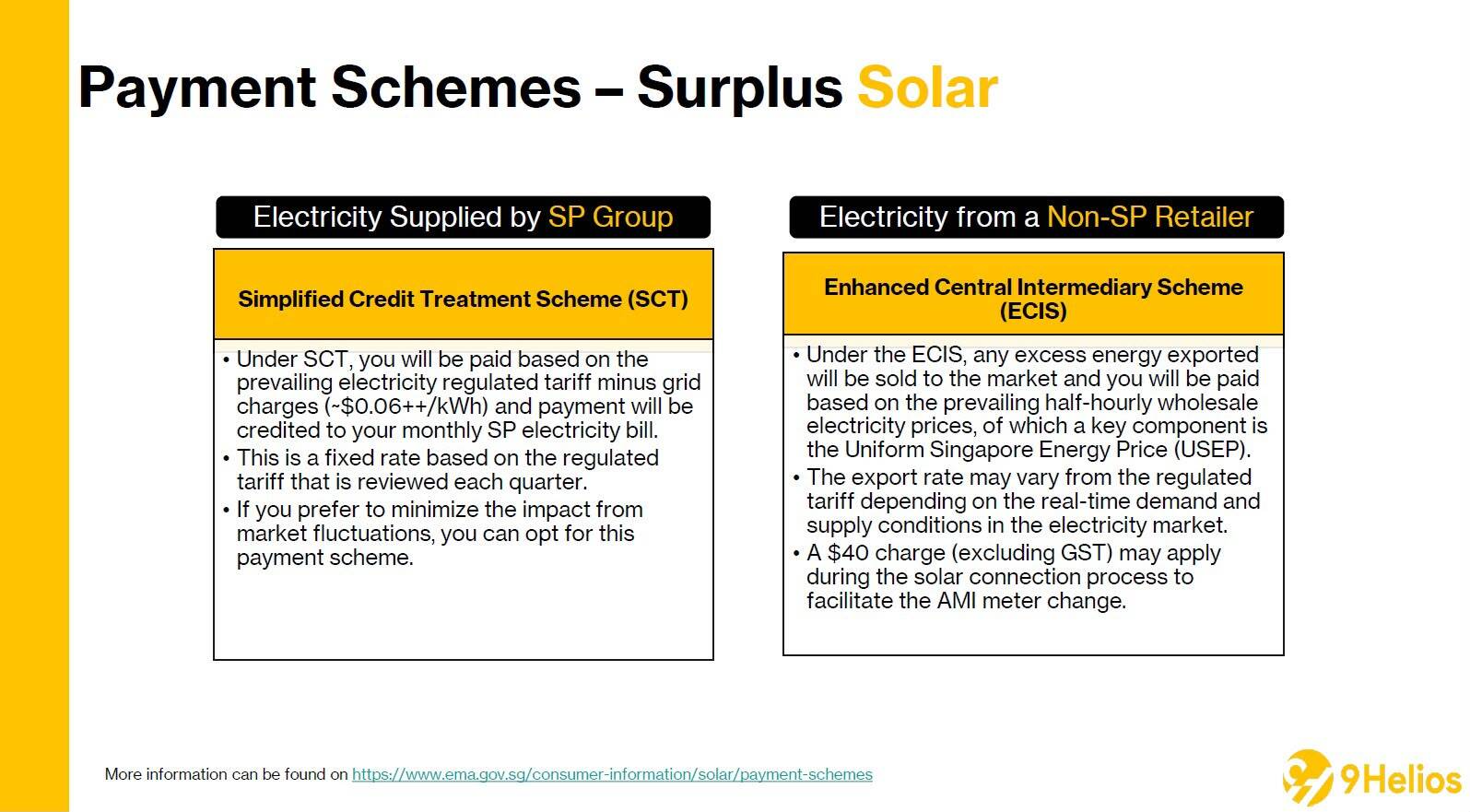
Singapore’s electricity market splits consumers into two groups. Non-contestable consumers buy electricity from SP Group at the regulated tariff. Contestable consumers buy from an electricity retailer, for example on an Open Electricity Market plan. That split decides your solar payment scheme.
| SCT | ECIS | |
|---|---|---|
| Full name | Simplified Credit Treatment Scheme | Enhanced Central Intermediary Scheme |
| Who it is for | Customers who buy electricity from SP Group | Customers who buy electricity from a retailer |
| How you are paid | Regulated tariff minus grid charges | Prevailing half-hourly wholesale electricity price, of which USEP is a key component |
| Does the rate change? | Fixed, reviewed each quarter | Varies with real-time supply and demand |
| How payment arrives | Credit on your monthly SP bill | Rebate through SP Services, reflected on your SP account |
| Best if you want | Stable, predictable export income | Exposure to market prices |
Solar panels work by converting sunlight into electricity that your household can use throughout the day. This means that instead of purchasing all your electricity from the grid, you can generate a portion of it yourself.
For homeowners in Singapore, this is particularly useful because the country receives consistent sunlight throughout the year. With a properly designed solar PV system, you can make use of your rooftop to produce electricity and reduce your reliance on conventional energy sources.
Simplified Credit Treatment Scheme (SCT)
Under SCT, you are paid based on the prevailing regulated electricity tariff minus grid charges, and the payment is credited to your monthly SP electricity bill.
The grid charge covers electricity infrastructure maintenance and transporting power, which are costs SP Group carries rather than the household that exports. 9Helios’ customer guide puts the grid charge at roughly $0.06+ per kWh.
The SCT rate is fixed and reviewed each quarter, so it is not exposed to market swings. If you prefer to minimise the impact of price fluctuations, SCT is the scheme built for that.
Enhanced Central Intermediary Scheme (ECIS)
Under ECIS, the excess energy you export is sold to the wholesale market, with SP Services acting as the central intermediary. You are paid based on the prevailing half-hourly wholesale electricity prices, of which the Uniform Singapore Energy Price (USEP) is a key component.
Because this price follows real-time demand and supply conditions, the export rate can sit above or below the regulated tariff.
EMA offers ECIS to contestable consumers with less than 10 MWac of embedded solar capacity. That covers homeowners on a retailer plan as well as SMEs with rooftop solar.
Can you choose between SCT and ECIS?
Not freely. The scheme follows your electricity supplier. If you stay with a retailer, you cannot pick SCT, and moving back to SP Group is what puts you on SCT.
Before you switch to a retailer, compare the export treatment as well as the discount on the electricity you buy. A cheaper retail plan can still cost you money if you export a lot of solar.
Step 2: Register for the net export rebate
You won’t get paid for exported solar unless you sign up first. The process is the same for both schemes, with a few extras for ECIS.
- Complete the Net Export Rebate Application Form from SP Group. 9Helios prepares the form for you.
- The form must be submitted by a Licensed Electrical Worker (LEW) through the SP Services e-Business portal. 9Helios processes your signed form and passes it to the LEW for onward submission, so you do not need to liaise with another party.
- If you want payment by bank transfer, submit the Interbank GIRO application together with the form.
- ECIS only: register with the Energy Market Company (EMC) as a Market Participant. A $40 charge (excluding GST) may apply during the solar connection process to cover the AMI smart meter change.
- For questions about registration, email install@spgroup.com.sg.
If you are on ECIS and do not want to be paid for exports at all, you can register your system as a Non-Exporting Intermittent Generation Facility (NEIGF).
You then pay an estimated fixed charge every six months, based on your system’s nameplate rating. Most households that export regularly will prefer to be paid.
How much will you earn from excess solar?
Your monthly export income is simple to estimate:
Monthly export income = kWh exported x export rate per kWh
Your solar monitoring app or SP bill shows the exported kWh. The export rate depends on your scheme.
Understanding USEP
USEP stands for Uniform Singapore Energy Price. It is the wholesale electricity price in Singapore’s market, which is operated by the Energy Market Company (EMC).
EMA publishes the monthly average in dollars per megawatt-hour ($/MWh). To compare it with a retail tariff, divide by 10 to get cents per kWh.
Here are the 2026 monthly averages, from the EMA data published in November 2026:
| Month 2026 | USEP ($/MWh) | Cents/kWh |
|---|---|---|
| January | 118.6 | 11.9 |
| February | 132.9 | 13.3 |
| March | 160.4 | 16.0 |
| April | 194.5 | 19.5 |
| May | 181.1 | 18.1 |
| June | 205.6 | 20.6 |
| July | 245.2 | 24.5 |
| August | 332.5 | 33.3 |
| September | 411.7 | 41.2 |
| October | 357.4 | 35.7 |
Source: Energy Market Company (EMC), via EMA Average Monthly USEP.
A simple average of the monthly figures gives about 23.4 cents/kWh for January to October 2026, compared with about 11.7 cents/kWh across 2025. USEP is volatile over the longer term too.
EMA’s series runs from about 44 $/MWh in April 2016 to above 490 $/MWh in October 2021 and May 2023.
Treat this table as a market price reference, not a guaranteed payout. ECIS pays the half-hourly wholesale price, and USEP is only a key component of it.
Solar exports also happen in the daytime, while the monthly USEP averages every hour of the day, so your realised rate can differ.
What this looks like in dollars
The table below shows what 300 kWh of exports in a month would be worth at different rates. These rates are illustrations only, not current SCT or ECIS rates.
| Illustrative export rate | Value of 300 kWh exported |
|---|---|
| 15 cents/kWh | $45.00 |
| 20 cents/kWh | $60.00 |
| 25 cents/kWh | $75.00 |
| 35 cents/kWh | $105.00 |
For the current SCT rate, check SP Group’s latest regulated tariff, since it changes every quarter. For ECIS, your rate moves with each half-hour of market pricing.
How export income affects your solar payback
Most customers ask about payback when they ask about surplus solar. Your payback period depends mainly on how much electricity bill you avoid through self-consumption, with export income shortening it further.
A system sized for your daytime usage exports less but saves more per kWh. A larger system exports more, which makes the export rate more important to your return. Either way, knowing your scheme helps you judge the numbers a solar quote shows you.
Step 3: How the rebate shows on your SP bill
SP Services sends one combined utilities bill. It can carry electricity, water, waterborne tax, refuse removal and gas charges. Your net export rebate is applied to that account as a credit.
- SCT customers: the credit is applied as an adjustment to your monthly electricity bill. If the credit is larger than the bill, the unused balance carries forward to the next month rather than being paid out automatically.
- ECIS customers: the rebate is reflected as an export rebate on your SP account. Your electricity usage is billed by your retailer, so your SP bill has no electricity line, only water and other utilities. The rebate then works against a much smaller bill, and a credit balance can build up faster.
- Look for: the exported kWh, the rate applied and the rebate amount. Line names can vary, so compare them against your solar monitoring data.
A bill that reads $0.00 does not mean your credit is gone. Check the credit balance line, because that is the amount you can later withdraw.
Step 4: How to withdraw your accumulated solar credits
Credits do not turn into cash by default. You have two main routes.
Option 1: Set up GIRO
The simplest approach is to nominate GIRO when you register. EMA directs consumers to submit the Interbank GIRO application together with the Net Export Rebate Application Form, and this applies to both SCT and ECIS.
If your system was registered without GIRO, ask SP Group whether you can add it so future payments arrive automatically.
Option 2: Request a refund of your credit balance
If you already have a credit balance, request a refund from SP Group. The usual route is the SP Utilities Portal or the SP app, where you open the refund request option, select your utilities account, enter the amount and your receiving PayNow or bank details, and submit.
You can also use SP Group’s online enquiry form or call its customer service line. Keep the confirmation and reference number.
Have these ready before you start:
- Your SP utilities account number
- Your latest utilities bill showing the credit balance
- A PayNow or bank account in the same name as the SP account holder
- Your net export rebate application reference number, which your installer or LEW can provide
Why a refund can stall
- Name mismatch: the receiving account must match the SP account holder’s name.
- Estimated readings: if a bill is based on an estimate, your exported kWh may look off until the next actual reading.
- Unclear request: ask for a reference number and an expected processing date when you submit.
Tips to get more from your surplus solar
- Shift usage to daytime. Run the washing machine, dishwasher and EV charger when the sun is out, so you use your own solar instead of exporting it at a lower rate.
- Compare export rates before changing retailer. Moving between SP Group and a retailer also moves you between SCT and ECIS.
- Check your bill each quarter. The SCT rate is reviewed quarterly, and ECIS payments move with the market.
- Keep your system clean and monitored. Lower output means less surplus. See 9Helios’ solar system maintenance service.
- Ask about renewable energy certificates. Homeowners who resell at least 1 MWh of solar energy a year may qualify for RECs, which EMA notes most landed homes can reach.
Larger systems and commercial solar
Businesses with rooftop solar follow the same principle, with different thresholds.
Contestable consumers with less than 10 MWac use ECIS.
Those with 10 MWac or more register directly with the Energy Market Company to sell their excess solar-generated electricity.
If your business is exploring solar, see 9Helios’ commercial solar panels page.
Final thoughts

Knowing how to sell excess solar energy comes down to three things: knowing your scheme (SCT or ECIS), registering for the net export rebate, and choosing how you collect your credits through GIRO or a refund request.
Keep an eye on your SP bill, and remember that using more of your own solar during the day is usually worth more than exporting it.
If you are planning a system, 9Helios can help you size it for your usage and understand your export options. Explore residential solar panels or contact the team for a quote.
For the official details, see EMA’s payment schemes page and its average monthly USEP data.